
Most leaders know the meeting. Everyone nods, the decision is recorded, and the real disagreement begins in the corridor afterwards.
A meeting without disagreement may mean there is genuine alignment. It may also mean the cost of raising a concern has become too high. That is not a conflict-free business. It is a business where conflict has been pushed out of sight.
Conflict is often treated as a disruption to delivery – something to contain, smooth over or send to Legal. In complex work, however, it is a predictable consequence of competing priorities, incomplete information and genuine differences about scope, risk, performance, timing and money. The leadership question is not how to prevent every disagreement. It is how to make disagreement useful before it hardens into a dispute.
Not all conflict is useful
That distinction matters. The evidence does not support the simple idea that more conflict produces better results. Relationship and process conflict are consistently associated with poorer group outcomes. Task conflict – disagreement about the work, evidence or decision – can be valuable in some settings, particularly when it remains separate from personal friction and sharpens decision quality (de Wit, Greer and Jehn, 2012).
The leadership work is to preserve that boundary: challenge the proposal, not the person; test the assumption, not the motive; and make the disagreement specific enough to work with.
This is where psychological safety earns its place in the conversation. It is sometimes mistaken for comfort or consensus. In practice, it is the confidence to raise a risk, admit uncertainty or question the prevailing view without paying an interpersonal price (Edmondson, 1999). Leaders create that confidence in small moments: asking, ‘What are we not seeing?’, inviting the dissenting view, and responding to unwelcome information with curiosity rather than defensiveness.
Hold two concerns at once
Conflict is also mishandled when leaders accept a false choice: protect the commercial position or preserve the relationship. The dual concern model offers a more mature lens. It considers both concern for our own outcome and concern for the other party’s outcome. When both are high, problem-solving becomes more likely (Pruitt and Rubin, 1986).
That does not mean splitting the difference or keeping everyone happy. It means being clear about rights, risks and non-negotiables while taking the other party’s interests seriously. A robust position and a workable relationship are not mutually exclusive. Even where a binding decision is ultimately required, the way the pathway is chosen and managed will affect trust, credibility and the prospect of working together again.
Slow instinct, not action
When pressure rises, speed can look like competence. A formal notice is sent, senior people are copied in, a meeting is refused, or a position is locked down before the facts are fully understood. Sometimes that response is justified. Sometimes it simply turns discomfort into escalation.
A useful discipline is to test the next decision against three questions: Pressure, Trust and Time.
Pressure - Trust – Time
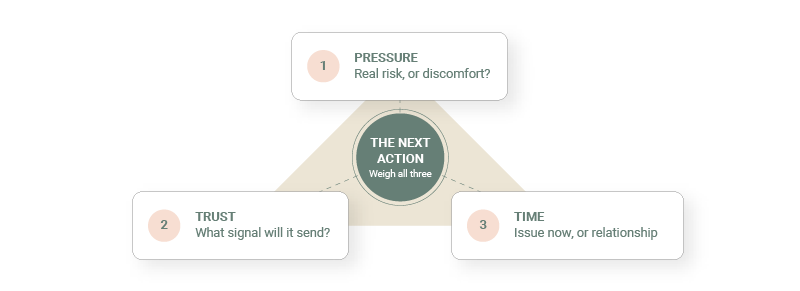
Pressure. What is actually driving the urgency? Is there a real legal, safety, financial or delivery risk – or are we reacting to the discomfort of not yet having an answer?
Trust. What signal will the next action send? Will it increase predictability and credibility, and preserve dignity on both sides?
Time. Are we optimising for the immediate issue or the longer relationship? What precedent are we creating for the next difficult conversation?
Give conflict the right structure
Once conflict becomes a dispute, leaders can behave as though only two choices remain: settle it privately or litigate. That is far too narrow. Alternative dispute resolution offers a spectrum of processes that can be matched to what the case actually needs.
A direct conversation or facilitated negotiation may be enough when the issue is still fluid. Mediation can help parties move beyond stated positions, explore interests and test practical options while there is still a relationship to protect. Early neutral evaluation can bring realism to differing views of the merits. Expert determination can unlock a discrete technical issue. Where certainty or enforceability is required, adjudication or arbitration can provide a binding outcome through a process designed for the case.
The important point is timing. ADR should not be treated as the final attempt after positions have calcified and trust has been depleted. Agreed escalation steps and well-designed dispute resolution clauses are not signs of distrust; they are relationship infrastructure. They give people a known path to follow when judgement is under pressure.
Bringing in a neutral is not handing leadership away. It is a leadership decision to give conflict enough structure to become manageable, and to use a process proportionate to the issue, the relationship and the outcome required.
Resolution should leave the business wiser
A signed settlement, determination or award may close the case, but it does not automatically create learning. Leaders should still ask: When did we first see the warning signs? What did we delay or avoid? Which process failed? What was the impact on the relationship? What will we change next time?
A resolution that closes the file but changes nothing can be an expensive form of amnesia.
Conflict is inevitable. Damage to trust is not. The strongest leaders are not conflict-free; they are conflict-capable. They make it safe to surface what others would rather leave unsaid, keep disagreement focused enough to remain useful, and recognise when an independent process is the wisest next step. Handled this way, conflict stops being an interruption to leadership. It becomes one of the places leadership is most visible.